
home > interesting topics > random musings > how did i ever believe
How Did I Ever Believe It Was the Truth?
After you realise Jehovah’s Witnesses do not teach the truth, it is common to struggle comprehending how you ever believed it was. Much of what you believed seems ludicrous, harmful, and even immoral. Understanding why Jehovah’s Witnesses believe it is the truth, as you once did, is an important step in being able to move on.
The question of why you believed it was the truth can be broken into two parts, why you started to believe, and why you continued to believe.
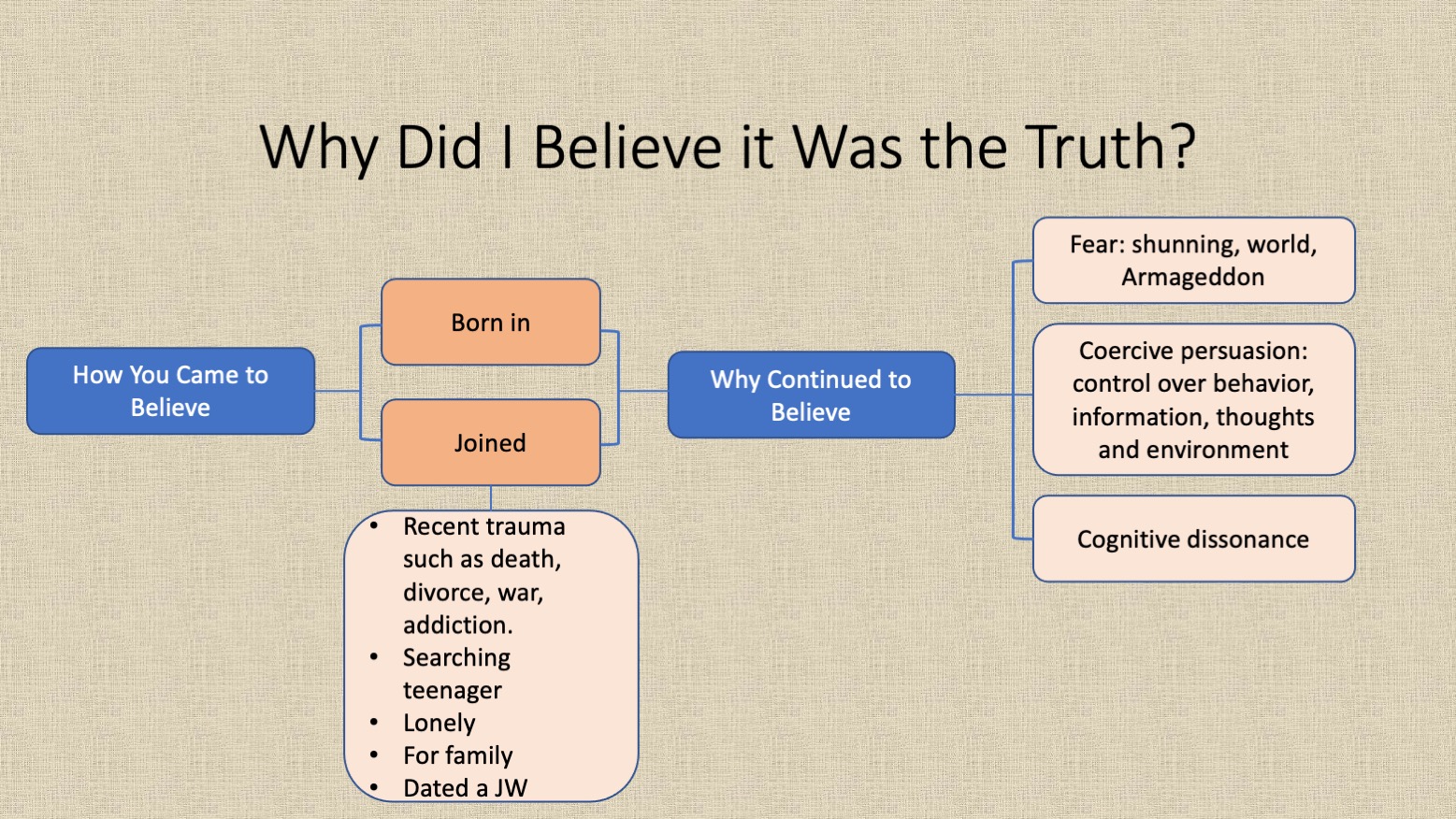
Why You Came to Believe
Born In
Most Jehovah's Witnesses did not choose their religion or what to believe, it was given to them at birth. You were mostly likely born into the religion and constantly inculcated with Watchtower’s belief system. You were encouraged to become baptised as a teenager, before you had exposure to other viewpoints or the maturity to differentiate between belief systems.
Joined
Few people join the religion.
It takes over 7,000 hours of preaching for a single baptism, and most of those are children born into the religion. The billions of hours of preaching that Jehovah's Witnesses reported each year only results in a small amount of new converts, particularly since the twenty first century.

People do not join as a result of deeply researching all possible religious ideologies and determining Watchtower doctrine is correct - to do so would be impossible. Some people may have studied a handful of religions and felt Watchtower teachings seem the most closely aligned to the Bible. Whilst Watchtower doctrine seems solid, it fails at many levels under closer scrutiny.
Those that join usually do so after having recently experienced trauma and being vulnerable to the message of a paradise earth and promise of a group of friends. If you joined as an adult, this likely refers to you. This doesn’t mean you did not do what seems to be thorough research. Watchtower has developed a solid doctrinal base, taken from Protestantism and the Adventist movement of the nineteenth century, and built upon over the last 150 years. Key doctrine is supported by a handful of scriptures and repeated in publications ad nauseum, with only superficial and inaccurate presentation of alternative points of view. Few people have a deep enough theological understanding to comprehend why these are wrong.
You do not need to feel any guilt or shame for believing Watchtower was Jehovah’s organization, as you were either too young to make an informed choice in what to believe or joined during a time when you were vulnerable to a well-crafted message.
Why You Continued to Believe
Why did I remain one of Jehovah's Witnesses for so long? That question plagued me for years. Was I stupid, was I weak? Neither intelligence nor emotional strength determine how long someone remains one of Jehovah's Witnesses.
Watchtower is considered a high control group that uses coercive persuasion to influence followers’ beliefs and behaviours. (See Watchtower Control.) A large amount of time is expected to be devoted to studying Watchtower publications, attending meetings and preaching. The leaders are expected to be trusted, and contradictory information avoided. Association is predominantly with other members. Such insularity makes it difficult for a follower to gain enough disparate information to come to alternative viewpoints.
When you find reasons to question Watchtower beliefs, another layer of influence takes control - fear. Watchtower constantly vilifies the evil world and discusses the disastrous consequences of those that leave. The imminence of Armageddon and its horrors are regularly presented. Even if you see through these fearmongering tactics, you then have the all too real fear of being shunned by your loved ones if you leave.
Cognitive dissonance then comes into play. Cognitive dissonance refers to the human trait of holding to a belief that is obviously wrong, to avoid the consequences of changing that belief. This is not a conscious choice, but subconscious rejection of alternative viewpoints as a coping mechanism. The fear of being shunned, left without a belief system, or admitting your life has been based on lies, invokes cognitive dissonance. It is easier to quash any questions with unrealistic justifications than confront the consequences of accepting your core belief system is wrong.
It takes a great deal of awareness to arrive at the point of accepting that Watchtower is not Jehovah’s organization. This is not where it ends, as you are now presented with the impossibly difficult choice of leaving, because Watchtower uses the threat of being removed and shunned as a weapon to force compliance. The anacronym PIMO - physically in, mentally out – is used to describe those that realize that Watchtower is not the truth but feel forced to feign being Jehovah's Witnesses to avoid being disfellowshipped and retain contact with family. This is neither dishonest or weak, as it is necessitated by the dishonest and controlling nature of the religion.
You came to believe Watchtower teachings due to circumstances that prevented a comprehensive evaluation of its merits. You stayed because roadblocks are in place to prevent you being able to comprehend why they are wrong.
It is common to feel guilty about the person you were, and judgemental towards those that remain Jehovah’s Witnesses. You do not need to feel such guilt or anger and doing so will prevent you finding contentment in your life. You are not bad for being one of Jehovah's Witnesses, nor are they that remain, even though some of the beliefs and practices may be considered bad.
Never feel ashamed that at one time you believed Watchtower doctrine and trusted the Governing Body. Be proud that you were aware and strong enough to overcome Watchtower coercion and leave.
Written Jan 2026, latest update Jan 2026.
 Paul Grundy 2005 - 2026