
home > interesting topics > random musings > hell or armageddon
Is Hell or Armageddon more Fearful?
High Control religious organisations use fear as a motivating factor to follow their rules. Watchtower criticises the concept of eternal torment in a fiery hell yet has the threat of being killed at Armageddon. Which is worse? Is it more damaging to be raised in a religion that controls its followers on the premise of eternal torment in hell, or being murdered at Armageddon by Jehovah’s forces?
It is not possible to arrive at an objective answer to this question, as each follower is uniquely affected by such concepts. These teachings are uniquely experienced psychologically and socially, based on the individual’s temperament, upbringing, and circumstances. It is important to understand the affect these teachings can have on adherents and those that leave religions that promote such teachings.
Fear of Armageddon
Watchtower’s teaching of Armageddon can result in chronic fear, anxiety, shame and existential dread of death at Armageddon. It can lead to guilt-based morality, leading believers to act out of fear, not love or conscience.
Watchtower teaches that death at Armageddon is eternal, and salvation is dependent of being part of the Watchtower organisation - see Salvation Only For Jehovah's Witnesses. This means billions will die without hope of a resurrection.
I came to know that many of my Jehovah’s Witness family and friends that had left were still terrified by the belief that they were going to die at Armageddon. Some had left because they felt they could not live up to Watchtower standards, others no longer believed Watchtower teachings, yet they still carried an irrational fear of death at Armageddon.
Interviews with those that have left Jehovah’s Witnesses shows that it is common for continued dread of Armageddon to remain.
“The effects of day to day living outside of the JWs while retaining a residual JW identity appeared to be associated with a significant sense of foreboding. Respondents generally spoke about the association between leaving the JWs and their perceived death at Armageddon as a constant source of anxiety, which seemed to indicate a strong residual JW identity. One participant noted “I still mentally believed it for a long time after I left…two years I would say…I was checking the news a lot, for signs (of Armageddon)…it was always drummed into you as a JW to check for signs…I was going to die at Armageddon, and if I died, or if something happened to me, I wouldn’t get a resurrection” (Sarah). Here, the residual JW identity of this respondent appeared to exert a powerful influence over her ability to break free of her previous belief system and generated an apocalyptic fear associated with negative self-perceptions. This suggests that former JWs may struggle psychologically in terms of post-exit paths because of a maintained belief in the doomsday nature of JW eschatology. This effect was so strong in some respondents that they talked about being disfellowshipped as a freedom as worth dying for. One respondent explained “if Armageddon were to come, I’d expect balls of fire to come falling from the sky...and if it came, and I was destroyed…I’d rather die happy than live miserably” (John). Here, the respondent talked about believing the doctrine of Armageddon to such an extent that he views dying happy as more appealing than living miserably (as a JW). This seems to indicate that some former JWs may choose a life outside the religion despite a continued perceived threat for failing to live in accordance with mandated standards. The description of fire was used by another respondent who exhibited a particularly strong fear of Armageddon. She related, “I felt that I didn’t have the protection of God anymore after I left… and I started to have nightmares about it, about being burned…and Armageddon…pretty bad violent dreams” (Laura).” Leaving the Jehovah’s Witnesses: Identity, Transition and Recovery EDGE HILL UNIVERSITY HEATHER J RANSOM 2021
Fear of Armageddon is so strong because it is presented as about to occur at any moment, proven by catastrophic events currently occurring.
“We were trained to view headlines through an eschatological lens, filtering every earthquake, war or summit meeting as a potential indicator of the end: the Cold War; the hole in the ozone layer; the Catholic Church naming 1986 as the “International Year of Peace”; Ethiopian famine and “Feed the World”; and the new environmental fear of “the greenhouse effect”, were all interpreted as evidence that the end of the world was at hand.” Peace, Security and Sudden Destruction: Waiting for Armageddon Dr George Locke 2025
One of the reasons I started jwfacts.com was to help former Jehovah’s Witnesses understand Watchtower’s teaching of Armageddon is not real or supported scripturally. Only by consciously researching how Watchtower indoctrinates people with this deeply instilled fear are people able to start to overcome the terror of death at Armageddon.
Fear is prevalent for Jehovah’s Witnesses, because Watchtower doomsday doctrine is constantly reinforced through weekly meetings, preaching and study of Watchtower publications. Even loyal Jehovah’s Witnesses fear Armageddon, as they are told they will soon suffer persecution and torture during the Great Tribulation to test their faith. As a child, I was terrified that I would be tortured by having toothpicks inserted under my fingernails or tickled until I suffocated. Other Jehovah’s Witnesses are terrified of shortly dying at Armageddon because they do not feel worthy of salvation.
At the 2023 Annual meeting, Watchtower slightly relaxed their teaching of who will survive Armageddon, allowing people to convert or return during the great tribulation.
"The first question is, once the great tribulation starts ... is there a door of opportunity for nonbelievers to actually join us in serving Jehovah? Is there a door opportunity? ... So let's think about some whom we know - perhaps unbelieving relatives, disfellowshipped ones, others who have heard the message and perhaps have studied with us. Could some of them, once they see the destruction of Babylon the Great, decide that what Jehovah's Witnesses were saying is correct after all? Could they take a stand for the truth? Well, if they changed their hearts and joined us, would we be disappointed? Now we can't be dogmatic, but we don't want to be like Jonah and say: "Oh, no, no, the door is closed, no, no." ... But could it be that once the great tribulation starts, many who have heard the message that Jehovah's Witnesses have preached may be in a position then to make the right decision, the right choice? Well, again we can't be dogmatic, but we certainly hope that that would be the case." Geoffrey W. Jackson: What Do We Know About Jehovah's Future Judgments? jwb-108-19.v starting 6:18.
Whilst this should be comforting to inactive Jehovah’s Witnesses, most are unlikely to be aware of this change, and continue to be tormented by the fear of dying at Armageddon.
People fear dying more than being dead and the potential of a murderous death is real and constant for Jehovah’s Witnesses.
Fear of Hell
"The possibility of enduring unspeakable torments in hellfire has made the whole subject of the final judgment at the hands of Jesus Christ something fearful to think about." Watchtower 1991 Aug 1 p.4
"The very thought of a burning hell has caused untold mental torment. … For centuries the dogma of hellfire has been drummed into the impressionable minds of youngsters and thundered from pulpits. … Proclaimers of hellfire have made the true God, Jehovah, appear to be a fiend—a cruel monster—instead of what he is: a God of love, “merciful and gracious . . . and abundant in loving-kindness.”" Awake! 1986 Apr 22 pp.26-27
Watchtower highlights that hellfire creates fear and mental torment, painting God as a cruel monster. Teaching eternal damnation and torture has similar consequences to Watchtower’s teaching of Armageddon - chronic fear, anxiety, shame and existential dread of punishment. It can lead to guilt-based morality, leading believers to act out of fear, not love or conscience.
The traditional view of hell was torment in eternal fire. Dante Alighieri’s Inferno (Part I of The Divine Comedy) famously outlined 9 levels of hell and multiple forms of torture.
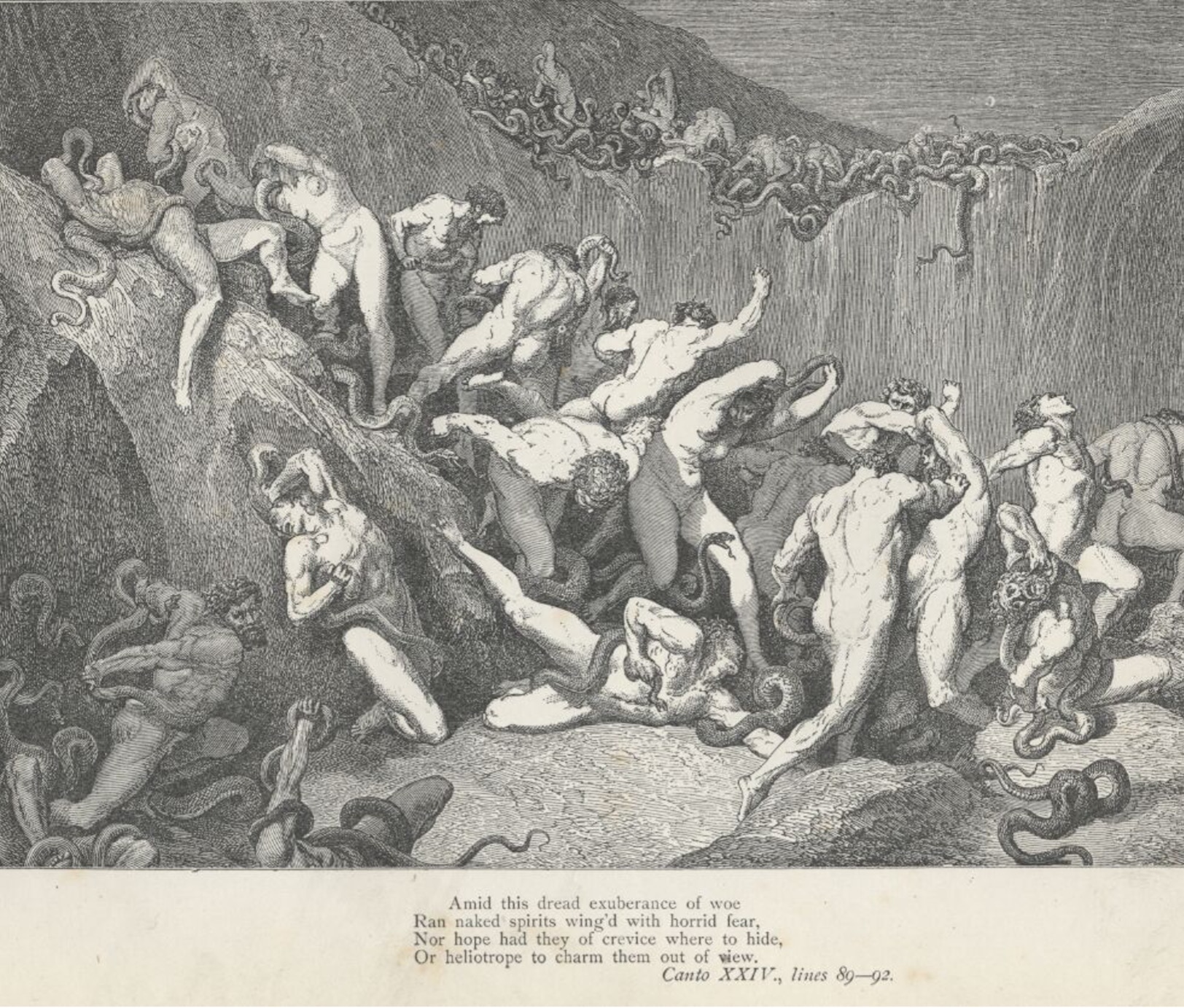
The Thieves tortured by Serpents: engraving by Gustave Doré illustrating Canto XXIV of the Inferno
The following Reddit comments show the terrible effect on some people raised with a teaching of a fiery hell.
Reddit Thread - Afraid of hell since a child
I find I am extremely paranoid about the afterlife or hell. What if God really is an evil tyrant? I have nightmares about it. I’ve obsessed over it ever since I was 10 years old. - therapyduck
I am currently experiencing the same overwhelming fear. Recently, I have been waking up with panic attacks every night over it. I wish I had any type of solution to offer but maybe just knowing that you aren’t alone can be helpful? It helps me to remember that this was a form of brainwashing that has been done to us and that this is pure fear from trauma, not punishment from God or conviction of some kind. - Moon_x_moon
I was raised Evangelical and spent my early 20s, after leaving church, afraid of hell. I couldn't bring myself to stop believing in God or caring about him because "what if he's real and I'm really going to hell?". - SunlitJune
A similar comment appears in the Yale research paper Really Believing in Hell.
“from the mind of a 7 year old … the memory of my friend going to hell was one of cold, immeasurable fear. … I spent many a night being terrified that the people I loved would go to hell.” Really Believing in Hell Keith DeRose, Allison Foundation Professor of Philosophy, Yale University
These experiences underscore that childhood anxiety and fear of eternal punishment can be deeply internalized from early religious teaching and linger long after belief changes or ends, resulting in nightmares, psychological distress and anxiety.
It should be noted that most people do not believe in hell being place of fiery torment. A Barna Group survey of U.S. adults found the following beliefs:
- 32% said hell is “an actual place of torment and suffering”
- 39% said hell is “a state of eternal separation from God’s presence.”
- 13% said hell is just symbolic.
- 16% were uncertain or didn’t believe in afterlife. Barna probes views on heaven & hell 31 Oct 2003
A Pew Research survey of U.S. Christian adults who identify as Christian, found 79% believe in hell as a place of eternal punishment. https://www.pewresearch.org/wp-content/uploads/sites/20/2021/11/PF_23.11.21_problem_of_evil.pdf? What this entails varies widely, and includes:
- A literal fiery hell
- A metaphorical separation from God
- Annihilationism - the wicked cease to exist
- Universalism - hell is temporary and all souls will eventually be reconciled to God Pew Survey - 23 Nov 2021.
Even within Catholicism, the modern view of hell is not literal torture, but rather separation from God.
“Catholic theology holds that there is an actual, literal hell. The Catechism of the Catholic Church states: “The teaching of the Church affirms the existence of hell and its eternity. Immediately after death the souls of those who die in a state of mortal sin descend into hell, where they suffer the punishments of hell, ‘eternal fire’” (No. 1035). That same section goes on to explain that “the chief punishment of hell is eternal separation from God.” Believe it; there is an actual, literal hell Father Kenneth Doyle 21 Feb, 2022.
Whilst 13% of Christians expect to end up in hell, there is a lack of consensus of what they expect hell to be like. Those that expect to go to hell are not usually the ones that believe it to be one of harsh punishment.
“According to an article in Christianity Today about this research, about half of Americans are absolutely convinced that there is a Hell. … Some 13% think it’s more likely than not that they will end up there.” “Hell Anxiety” 4 Apr, 2019.
“If you believe in a harsher form of hell, you’re pretty sure you’re not going there.” Who Worries About Hell the Most David Briggs 4 Feb 2019
The Hope of Religion
Studies show the hope religion provides believers results in higher levels of happiness for many. However, religious messages of punishment can lead to high levels of anxiety for others.
“We find that a belief in Heaven is consistently associated with greater happiness and life satisfaction while a belief in Hell is associated with lower happiness and life satisfaction at the national (Study 1) and individual (Study 2) level. An experimental priming study (Study 3) suggests that these differences are mainly driven by the negative emotional impact of Hell beliefs.” The emotional toll of hell: cross-national and experimental evidence for the negative well-being effects of hell beliefs Azim F Shariff, Lara B Aknin 2014
"Though the vast majority of research indicates that religiosity makes a positive contribution to a person’s mental health and can give meaning to life, both the positive and some negative effects of religiosity on mental health are discussed. The impact of religiosity on people’s mental health seems to correspond to the quality of their religiosity.
… Thus, a positive view of faith, through the optimism it generates, influences an individual’s overall psychosocial adjustment, which is an essential predictor of positive psychological states and improved mental health. In addition, it was found to lead to greater life satisfaction, better psychological adjustment, and less distress in people with psychiatric disabilities.
On the other hand, negative religious interpretations, such as believing that life adversities are a form of God’s punishment and other negative appraisals of God’s power and intentions, as well as a less secure relationship with a divine being (Papaleontiou-Louca 2023, p. 11; Pargament et al. 2011), will presumably lead to negative effects on mental health.” Religiosity: Is It Mainly Linked to Mental Health or to Psychopathology? Eleonora Papaleontiou-Louca 2024
“Religious trauma, a psychological phenomenon resulting from harmful religious experiences, significantly impacts mental health, often leading to conditions such as anxiety, depression, post-traumatic stress disorder (PTSD), and diminished self-esteem. … Dogmatic and authoritarian religious environments frequently impose strict rules and rigid interpretations of moral conduct, often accompanied by harsh penalties for non-compliance. These environments promote fear and shame, reinforcing the belief that deviation from prescribed norms is sinful or worthy of punishment. As a result, individuals may internalize these doctrines, leading to an enduring sense of guilt, self-blame, and low self-worth. This internalization can cause emotional repression, as individuals may feel unable to express doubts, fears, or alternative viewpoints without fear of ostracism or condemnation (Ward, 2011). Over time, the cumulative effect of living under such rigid systems can result in deep psychological distress and trauma.” The Impact of Religious Trauma on Mental Health
When comparing different religions, it is unknown the ratio of those that benefit from their religious beliefs, compared to those with negative consequences. Higher control fundamentalist religions adversely affect a great portion of members. Watchtower is a high control, works-based religion, and it is likely a higher proportion of Jehovah’s Witnesses suffer from the anxiety of not being worthy of salvation than members of Christians religions that teach faith in Jesus is the requirement for salvation.
Conclusion
Jesus said the wages sins pays is death, hence dying frees a person from paying for the sins they committed during their lifetime. This was the whole point of Jesus ransom sacrifice. It makes little sense that a person would have to endure eternal suffering or lose out on everlasting life for not following a sects set of rules. This is even more pertinent for people that have no understanding of a particular religious sects’ teachings required for salvation.
Watchtower’s teaching of death at Armageddon can be more traumatic than the concept of hellfire because violent death at Armageddon is visual and imminent, whilst hellfire is a distant, abstract concept, and sinners are aware they can repent with a death bed confession. Only a minority believe they or their loved ones will be sent to hell. Armageddon is more immediately harmful, because it is time-urgent, behaviour-policing, socially coercive and tied to shunning and identity loss. Fiery hell can be deeply distressing, but is less controlling in daily life, less socially punitive for leaving and increasingly de-emphasized in modern Christian teachings.
Whilst Watchtower’s teaching of eternal death may not appear to be as terrifying as the concept of eternal fiery torment in hell, the fear of Armageddon’s imminence and being killed at that time is a horrifyingly real and concrete concept. It is used to create constant, urgent fear. It leads to fear of “worldly people” that could entice you away from Jehovah’s organisation. It is used to justify shunning former members, including family. Its imminence affects life decisions regarding education, careers and medical choices.
Both the concept of torture in an afterlife, or destruction at Armageddon, are evil and used to motivate followers by fear. I am sure some readers will be thinking how dare I question what the Bible says about God's punishment of sinners. No I am not, when there is no agreement on how God will treat wrongdoers, some saying it is hell-fire, others say it is Armageddon. These religious leaders are cherry-picking Scriptures to arrive at their own fear mongering interpretations. Likewise with various sects of Buddhism and Islam that share similar concepts of punishment. They are all equally sure their teachings are correct, and all likely to be equally wrong.
The following research paper discusses “Hell anxiety” and how therapists should attempt to show the patient they do not have a “likelihood of going to hell.”
“Indeed, as previously mentioned, a belief in Hell may cause an intense amount of anxiety in a “rational” sense. This may complicate the efforts of mental health professionals who rightfully wish to respect the religious views of patients who exhibit symptoms of Hell anxiety. However, as seen above, many individuals believe in Hell, often with all of the negative characteristics traditionally ascribed to it, without suffering from Hell anxiety. This research suggests that mental health professionals working with patients suffering from Hell anxiety should explore different ways to help the patient frame their beliefs in such a manner so as to lower the patients’ self-perceived likelihood of going to Hell.” Hell anxiety as non-pathological fear Stephen Cranney, Joseph Leman, Thomas A. Fergus & Wade C. Rowatt 2018
Watchtower teachings result in similar anxiety and those that have been associated with Jehovah’s witnesses likewise require assistance to recognise they will not die at Armageddon.
Written Jan 2026.
 Paul Grundy 2005 - 2026